
Area
Kyparissia is the third most populous town in Messinia, after the prefectural capital Kalamata and Messini. In the last census conducted in 2011, it had 8,877 inhabitants. It is built in an amphitheatrical position, stretching from the foot of Mount Aigaleo, also known as “Psichro,” to the waters of the Ionian Sea. It is the capital and seat of the municipality of Trifilia. It is located 255 km southwest of Athens, 63 km south of Pyrgos, 100 km southwest of Tripoli, 67 km northwest of Kalamata, and 74 km north of Methoni.

Its history is extensive and parallels that of the Peloponnese. Its origins are lost in the mists of prehistory. In Homeric times, Kyparissia was called “Kyparissias” and belonged to the kingdom of Pylos, ruled by King Nestor. In fact, during the Trojan War, Kyparissia sent 11 ships under the command of Nestor, according to Homer. Later, the region was subjugated by the Spartans along with the rest of Messenia. Kyparissia was a culturally, economically, and commercially thriving city. In fact, in 199 BC, it minted its own currency. Many were interested in the strategic location of the city over the centuries: A castle was built on the site of the ancient Acropolis during the Byzantine period (one tower became known as the “Tower of Justinian”), then the Turkish and Frankish conquerors rebuilt the fortress, making the necessary additions to give it its current form. During the Ottoman occupation, Arkadia, as Kyparissia was called in the Middle Ages, enjoyed a privileged position as the commercial center of the region, and its castle was guarded by a garrison of 300 Algerians.

Its current name is attributed to Otto. Tombs from the Classical and Roman periods have been discovered in Kyparissia, while at the top of Mount Psichro there is a Frankish castle. Name According to some, Kyparissia owes its name to the many cypress trees that surrounded it like forests at the dawn of its history, while others attribute it to Kyparissos. He was the son of Minyas. The myth always wants Kyparissos to be a good hunter and friend of Apollo, the god of music and light. Once, while hunting, he killed a deer. And from then on, he became melancholic. Before he died, the gods took pity on him and heard his pleas. They turned him into a cypress tree. And there were many cypress trees at that time in Kyparissia, the city where the god and friend of Kyparissos, Apollo, was worshipped. In Kyparissia, apart from Apollo, the goddess of wisdom, Athena, was also worshipped at that time.
Athena, who was worshipped in Kyparissia, was also known as “Kyparissos” or “Kyparissia” Athena, whose temple was located on the site of the present-day church of Agia Triada (it is said that the Holy Altar of the Temple rests on the remains of an ancient column). The temple of Apollo must have been where the old chapel of the horseman Agios Georgios stands today, near the entrance to the railway station. The god Dionysus was also worshipped there. Searching for its roots, we find the first references to Kyparissia in the verses of Homer. Even the great traveler and geographer of antiquity, Pausanias, passed through Kyparissia and made references, among other things, to the Dionysia spring (today’s Agios Lagoudis) on the city’s beach. …Those who built the Pylon and Arene, and Thryon, the port of Alpheus, and Euktius, and Kyparissia, and Amphigeneia, and Ptelos, and Helos, and Dorion, where the Muses were said to have stopped Thamyris the Thracian from singing, as he was riding by Eurytus of Oichalia.
Modern History of Kyparissia (Capital of the Province of Trifilia and later the Prefecture of Trifilia) The Prefecture of Trifilia (1899-1909) was an administrative division of the Peloponnese that has now been abolished. It was created with the administrative division of 1899, replacing the Province of Trifilia. The Prefecture of Trifylia was abolished in 1909 and its territories were incorporated into the Prefecture of Messinia as the Province of Trifylia. The prefecture consisted of: the Province of Trifylia and the Province of Olympia. The capital of the prefecture was Kyparissia. In 1909, the province of Trifylia had 51,004 inhabitants and the province of Olympia had 39,519, while the prefecture of Trifylia had a total population of approximately 90,000. The municipalities that made up the prefecture of Trifylia and their populations in 1909 were: Municipality of Kyparissia 10,122 Municipality of Aetos 4,302 Municipality of Avlon 5,571 Municipality of Dorion 6,247 Municipality of Erani 8,427 Municipality of Platamodos 8,574 Municipality of Tripili 3. 162 Municipality of Flessia 4,199 Municipality of Andritsaina 7,634 Municipality of Alifira 5,319 Municipality of Arini 6,809 Municipality of Volakos 5,002 Municipality of Skillountos 8,388 Municipality of Figaleia 6,387
The Olive Tree - The Fruit of the Olive Tree
Today, commercial olive production generally occurs in two geographical zones around the world, between 30º and 45º (North and South), where climatic conditions for cultivation and production are ideal. Most olive production takes place in the Mediterranean basin.

From a botanical point of view, the olive fruit is called a drupe, similar to a peach or plum.
Olives tend to have their maximum oil content (approximately 20-30 percent of fresh weight) and maximum weight six to eight months after the flowers appear. At that stage, they are black and will remain on the tree for several weeks.
Fresh, unprocessed olives are inedible due to the intense bitter taste of the fruit, which is caused by a substance called oleocanthal. In the Greek method of preparing black olives, the bitter taste is removed through fermentation (slow ripening). Olives are edible whether ripe or green.

Nowadays, the best type of olive for food is considered to be the Greek “Kalamata olive” (Kalamata olive). It is a large-fruited variety, cylindrical in shape and curved at the top. The color of this variety ranges from green to greenish-red, violet, and even deep blackish-violet. The size of the fruit ranges from 1.5 to 2.5 centimeters.
Kalamata (Kalamon) olives are top-quality black olives cured in vinegar or wine. They are very firm and have a very good flavor characteristic of the variety. They are produced naturally without chemical preservatives. This type of olive is found exclusively in Greece.
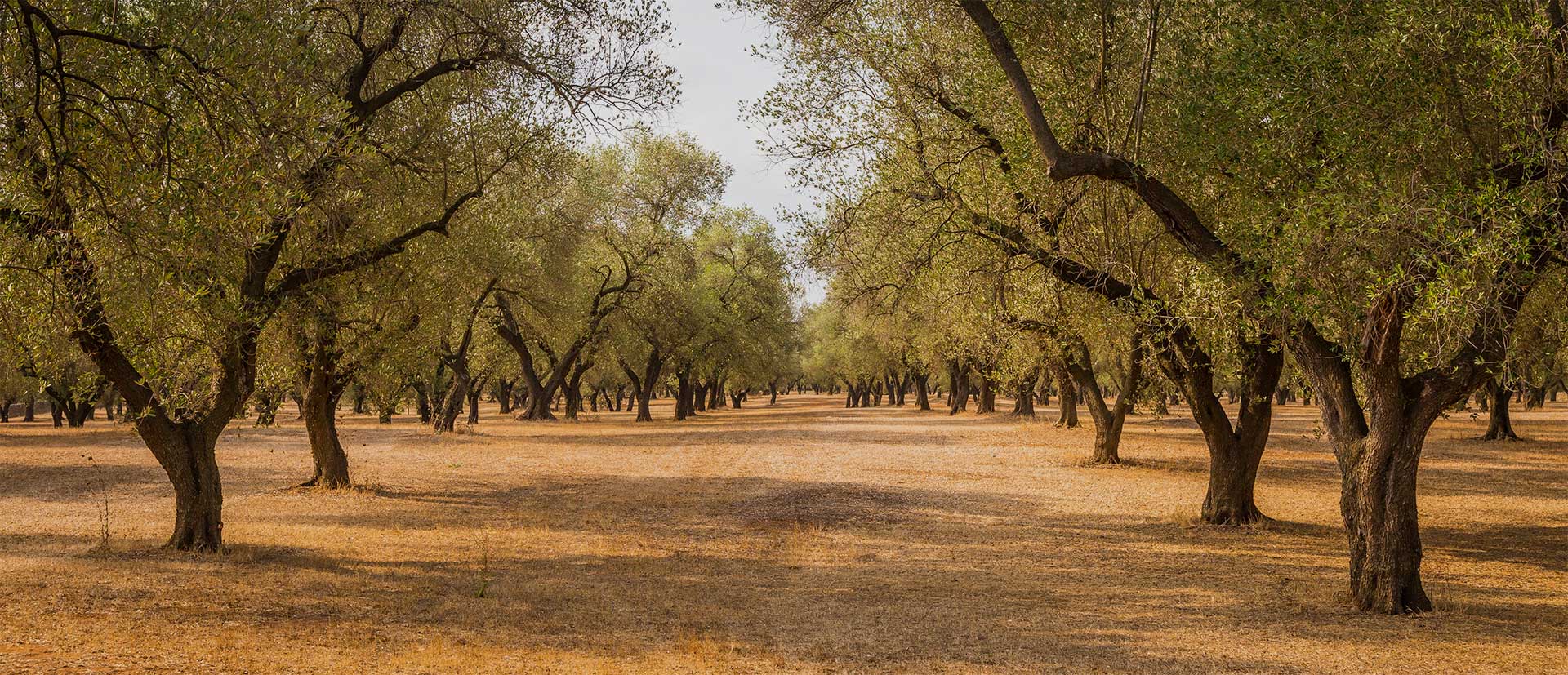
Kyparissia, formerly known as Arkadia, is a town of about 6,000 inhabitants, 65 km west of Kalamata. The town is almost entirely surrounded by olive groves and is geographically an ideal area for the production of Kalamata olives and olive oil.
In Greece, the most important varieties of table olives are the Konservolia and the Chalkidiki variety. In addition to these varieties, table olives are also produced from the Megaritiki, Korthiki, Igoumenitsa, Throumba, Thasos, Alexandroupolis, and Mytilene. The size of the fruit is determined based on the number of fruits contained in one kilogram.
The Olive Tree - Healing Properties
 Olive juice, otherwise known as olive oil, is a delicious source of antioxidants. This oil is monounsaturated and has a positive effect on cholesterol levels in our bloodstream. Monounsaturated fats are not considered “essential,” but they should be an important part of our diet. Olive oil acts to prevent cholesterol from sticking to the walls of our arteries. Not only that, but it helps control blood sugar, a big advantage in a controlled carbohydrate diet. Ultimately, when sugar is under control, insulin is also under control, which is a huge factor in the storage of food as fat in our bodies.
Olive juice, otherwise known as olive oil, is a delicious source of antioxidants. This oil is monounsaturated and has a positive effect on cholesterol levels in our bloodstream. Monounsaturated fats are not considered “essential,” but they should be an important part of our diet. Olive oil acts to prevent cholesterol from sticking to the walls of our arteries. Not only that, but it helps control blood sugar, a big advantage in a controlled carbohydrate diet. Ultimately, when sugar is under control, insulin is also under control, which is a huge factor in the storage of food as fat in our bodies.
Rich in antioxidants that strengthen the immune system, the Greek diet provides anti-cancer ingredients, healthy omega-3 fatty acids, and cleansing fiber, all of which help reduce the risks of diet-related diseases, including heart disease, obesity, and diabetes. A 2003 study conducted jointly by researchers at the University of Athens in Greece and Harvard University found that people who consumed a traditional Greek diet had a 33 percent lower risk of death from heart disease and a 24 percent lower risk of death from cancer.
Numerous studies, including one published by the American Heart Association, have shown that people who follow a diet rich in monounsaturated fats, such as the traditional Greek diet, have a lower risk of heart disease than people who eat more saturated fats, which are found in butter and margarine.
Researchers have also found that people who consume olive oil also have a lower risk of other diseases. Studies conducted at Harvard University’s Department of Public Health show a link between olive oil consumption and a reduction in the incidence of breast cancer and osteoporosis.
And a 1999 study conducted at the University of Athens Medical School showed that the Mediterranean diet may even help protect against rheumatoid arthritis. People who consumed olive oil and cooked vegetables had a 39 percent lower risk of developing this disease.